

Just an hour and a half from the capital, the Aisne department is home to unexpected treasures.
From the medieval heights of Laon to the meandering Oise River, via the heroic scars of the Chemin des Dames, this region invites you to step back in time. Between Art Deco architecture and social utopia… Here is your travel guide for sunny days, offering a complete immersion in the heart of the Laonnois and Thiérache regions.

Laon: the “Crowned Mountain” and its Upper Town
Rising from the plain, the Upper Town of Laon sits atop a 100-meter-high hill. This promontory, nicknamed the “Crowned Mountain” because of the silhouette of its cathedral and ramparts, is home to one of the largest historic preservation districts in France. A stroll through its cobblestone streets is an essential prelude before approaching the stone giant that is the Cathedral of Notre-Dame de Laon.
Notre-Dame de Laon Cathedral: Paris’s Twin
Did you know that Laon Cathedral is the twin of Notre-Dame de Paris? This architectural revelation strikes you the moment you see its ornate, sculpted towers. For a truly immersive experience, the south transept and its tower can be visited by reservation through the Tourist Office located at the foot of the building on Place du Parvis.
The guided tour, led by passionate guides like Lucie, takes you along the upper corridor of the south transept. There, you’ll discover an impressive row of 200 “slab tombs.” These are stones engraved with the likenesses of the deceased, a number of whom have been identified. These slabs were removed from the nave’s floor to be preserved and displayed here.
Don’t miss the wooden cabinet housing an antique clock: you can still see the word “Kommandatur” written in chalk—a reminder of the Occupation during World War II. From the first outdoor terrace, the view is breathtaking: on a clear day, you can see Saint-Quentin 50 km to the right and Soissons 30 km to the left.
If you’re not afraid of heights, you can continue on to the upper terrace.

Exploring the Underground Passages: From Quarries to Prisons
Beneath the cobblestones of the upper town lies a stone labyrinth. Laon’s underground passages, extending across three or four levels, tell a story spanning a thousand years. The current tour is organized around nine thematic sections that use projections to trace the evolution of these former limestone quarries.
For me, one of the highlights of the tour is the silo room. These grain storage tanks were converted into prisons as early as the 12th century. On October 13, 1307, members of the Knights Templar were imprisoned there by order of the king. You can also see graffiti left by these knights before they were transferred to stand trial in that historic case.

The Chemin des Dames: In the Footsteps of the Great War
A 30-minute drive south of Laon, not far from the Soissons region, the D18 road winds along a ridge steeped in history between the Aisne and Ailette valleys.
If you look closely at the edge of the road, you’ll notice a solid blue line: it marks the location of the front line. This “Chemin des Dames” owes its name to the two daughters of King Louis XV, who traveled along it just once to reach the Château de la Bove.
The Dragon’s Cave: An Underground Museum
The highlight of this memorial tour, the Dragon’s Cave is a former stone quarry that became a major strategic site during World War I. The Germans established themselves there in 1914 following the Battle of the Marne. This underground refuge changed hands seven times. It was the Germans who named this natural blockhouse “Drachenhöhle,” or the Dragon’s Cave, inspired by the smoke visible at each exit, which reminded them of the dragon’s lair in Wagner’s operas.
The tour reveals fascinating anecdotes, such as the origin of the horizon-blue uniform: beyond the birth of the concept of camouflage in modern armies, it was due to a shortage of red pigments (the famous madder red) that the French army opted for this more discreet gray-blue. During the tour, you’ll learn that a famous figure also left his mark here: Walt Disney served as a stretcher-bearer on this section of the front.
Memorial Villages and Panoramic Views of the Ailette
The tour continues toward Cerny-en-Laonnois, where British and French cemeteries stand side by side. Nearby, the Ferme d’Hurtebise illustrates the continuity of the fighting with its statue honoring the “Poilu” of 1914 and the “Grognard” of 1814. There is even a monument dedicated to the rugby players who fell in battle.
Did you know? It was here that General Nivelle was dismissed after the failure of his offensive, popularizing the expression “se faire limoger” (to be dismissed) in reference to his forced transfer to Limoges following the massacre of thousands of infantrymen under his command. The general was responsible for the deaths of 100,000 French soldiers in just eight days! A veritable bloodbath in French history.

Nature and Relaxation at Lake Ailette
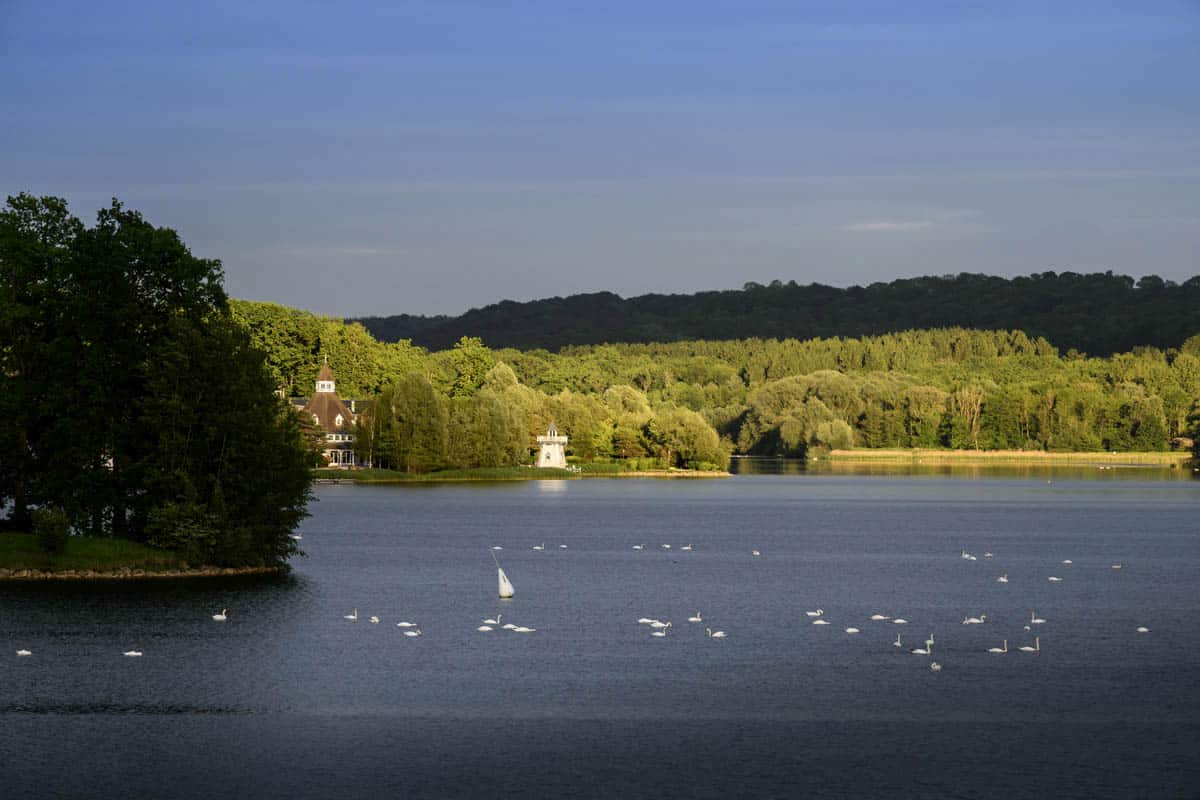
For a welcome, idyllic break at the end of the day, visit Lac de l’Ailette, located at the foot of the village of Chamouille and just a few kilometers from Craonne. This natural area—in the truest sense of the word—serves as an exceptional stopover for many migratory birds.
The Hôtel du Golf, right on the water’s edge, is the ideal stop for birdwatchers and those seeking tranquility. Spending one or two nights here makes it the perfect base for exploring the areas around Laon and Thiérache. Dining on the terrace on summer evenings, surrounded by nature and served by very friendly staff, is a truly pleasant experience, especially after a busy day.
The Familistère de Guise: Godin’s Social Utopia
Further north, in the heart of the Thiérache region, in Guise, stands the “Palais Social”—also known as the Familistère de Guise or the utopian workers’ community envisioned by Jean-Baptiste André Godin. In the 19th century, this former locksmith—deeply moved by the plight of workers during his Tour de France—built a revolutionary architectural complex for his employees.
The complex included 2,000 apartments—15 of which are still occupied today—a 1,000-seat theater, a laundry facility, shops, a swimming pool, and a secular, coeducational school established twenty years before the Jules Ferry laws. Women were able to vote there as early as 1880, well before women were granted the right to vote nationwide in 1944.


Don’t miss the laundry facility and swimming pool on the Oise River. The depth of the pool could be adjusted as needed. The Familistère is located on EuroVelo 3, the Scandibérique, and offers all the amenities needed for cycling stops.
The traditional local tavern, true to the region’s style and located next to the tour entrance and souvenir shop, looks very promising.
Saint-Quentin: Capital of Art Deco
The final stop on this journey: Saint-Quentin. While the City Hall miraculously survived the wars, the city was largely rebuilt after 1918 in the Art Deco style. There are no fewer than 3,000 typical ornaments and motifs in the streets of the largest city in the Aisne department.

The Basilica and Its Secrets
The Basilica of Saint-Quentin is one of the largest in France. It houses a 250-meter-long floor labyrinth that pilgrims once traversed on their knees for their redemption.
Given its historical and architectural significance, it is accepted—even within the clergy—to compare the Basilica of Saint-Quentin to a cathedral.

Le Buffet de la Gare: A Hidden Gem
As far as I’m concerned, the true, well-hidden architectural gem is undoubtedly the Café de la Gare. Usually closed to the public, this Art Deco masterpiece can only be visited by appointment with a guide from the Tourist Office. The interior has remained intact, offering a journey back in time to the Roaring Twenties. In Saint-Quentin, lunch at the Villa d’Isle restaurant, located on the main street—aptly named Rue d’Isle—allows you to fully immerse yourself in this decorative world.
To end the day on a relaxing note, the Parc d’Isle offers a moment of relaxation in the heart of the city with its wildlife park, red panda, and numerous water activities on the pond, as well as cultural events—especially during the summer months.

From the Gothic spires of Laon to the peaceful reflections on Lake Ailette, from the scars of the Chemin des Dames to the humanist ideals of the Familistère de Guise, all the way to the Art Deco facades and treasures of Saint-Quentin, this part of the Aisne harmoniously blends history, creativity, and warm-hearted locals. A land of history but also of renewal, the region offers the curious traveler a mosaic of emotions and discoveries. An authentic and endearing area that draws its strength from the absence of overtourism—and thus from delightful surprises.
People come to this part of the Aisne to explore, and they leave with an irresistible desire to return.

Practical Information
For general information about the region: www.jaimelaisne.com
How to get there: Take the TER train to Laon or Saint-Quentin station, about 1 hour and 30 minutes directly from Paris Gare du Nord. By car via the A1 or A26 (or via the pleasant back roads).
Laon Tourist Office: Place du Parvis in the upper town. tourisme-paysdelaon.com
Saint-Quentinois Tourist Office: 3 Rue Emile Zola. Phone: 03 23 67 05 00. destination-saintquentin.fr
Chemin des Dames and Caverne du Dragon: Visitor Center in Oulches-la-Vallée-Foulon. chemindesdames.fr
Hôtel du Golf on Lake Ailette: Phone 03 23 24 84 85. ailette.fr
The Familistère de Guise in Thiérache. familistere.com
Parc d’Isle in Saint-Quentin. Tel. 02 23 05 06 50. Event schedule available at agglo-saintquentinois.fr
🔵 Pour ne manquer aucune news sur InfoTravel, abonnez-vous sur Google Actualités. Et si vous nous adorez, on a une newsletter une fois par semaine.